
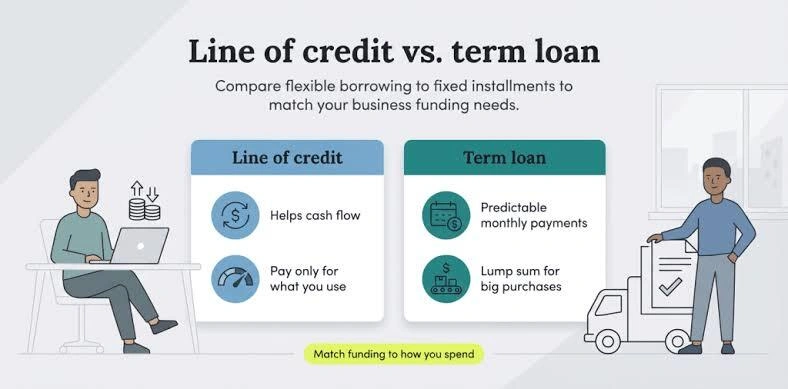
A business line of credit is a revolving credit account that provides access to funds over a defined period, allowing you to borrow, repay, and re-borrow up to a set limit [1][3][7]. Unlike a term loan, there is no lump-sum disbursement. Interest accrues only on the funds you draw, and your minimum payment fluctuates based on usage [1][3][9]. Chase, for example, structures its minimum monthly payment as 1% of outstanding principal plus accrued interest [1].
According to Bank of America, lines of credit are designed for short-term goals such as cash-flow management, seasonal fluctuations, inventory purchases, payroll, and unexpected expenses [3][7][10]. The revolving structure means a business that draws $20,000, repays $15,000, and then needs funds again can re-borrow without reapplying. Chase offers lines from $10,000 to $500,000 for existing customers, with a 5-year draw period and variable interest indexed to the Prime Rate [1]. This makes the product fundamentally different from a fixed installment loan, where the balance only declines. The flexibility is the core advantage for businesses with uneven revenue cycles.
How Business Lines of Credit Differ From Term Loans
The structural divide between business loans and lines of credit comes down to disbursement and repayment. A term loan provides a single lump sum repaid in fixed installments, while a line of credit functions like a reusable reserve [1][3]. According to the SBA, 7(a) term loans suit one-time investments such as equipment or real estate, where the full amount is needed upfront [2].
Interest treatment is the second major difference. With a line of credit, interest accrues only on drawn balances, so an unused $250,000 line costs nothing in interest until tapped [3][9]. Bank of America offers unsecured lines from $10,000 to $250,000 with variable rates; lines above $25,000 may require a blanket lien or a certificate of deposit as security [3][9]. For larger needs, Chase lines exceeding $500,000 shift to interest-only payments, terms up to 2 years, and an origination fee of 0.15% capped at $3,000 [1].
American Express Business Blueprint adds another model, permitting multiple outstanding loans simultaneously up to the approved line amount [6]. Choosing between the two depends on whether your funding need is recurring (favoring a line) or one-time (favoring a term loan).